
5 Stages in the Design Thinking Process
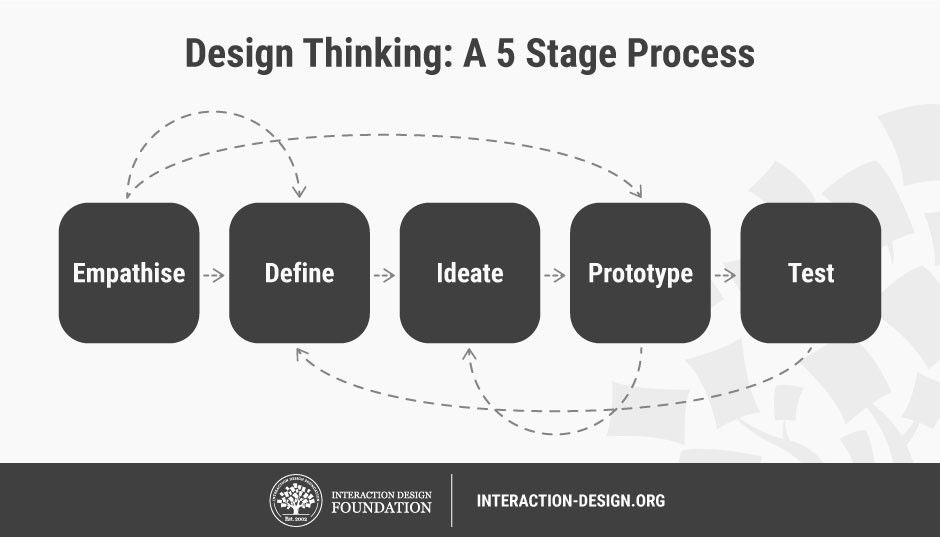
Design Thinking is a design methodology that provides a solution-based approach to solving problems. It’s extremely useful in tackling complex problems that are ill-defined or unknown, by understanding the human needs involved, by re-framing the problem in human-centric ways, by creating many ideas in brainstorming sessions, and by adopting a hands-on approach in prototyping and testing. Understanding these five stages of Design Thinking will empower anyone to apply the Design Thinking methods in order to solve complex problems that occur around us — in our companies, our countries, and even our planet.
The Non-Linear Nature of Design Thinking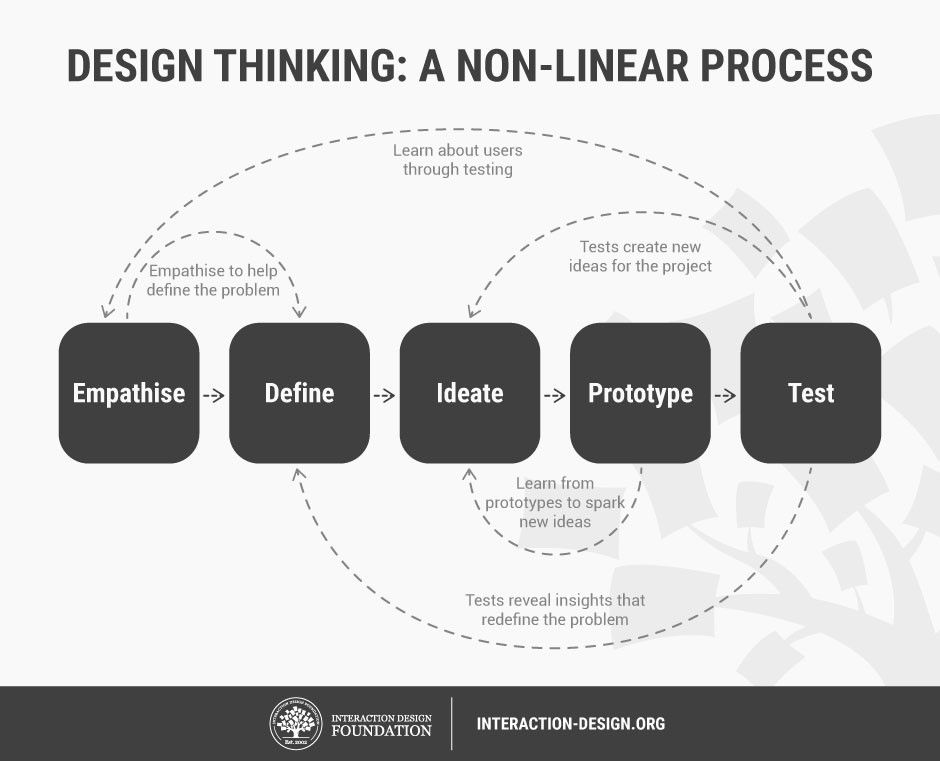
We may have outlined a direct and linear Design Thinking process in which one stage seemingly leads to the next with a logical conclusion at user testing. However, in practice, the process is carried out in a more flexible and non-linear fashion. For example, more than one stage may be conducted concurrently by different groups within the design team, or the designers may collect information and prototype during the entire project so as to enable them to bring their ideas to life and visualise the problem solutions. Also, results from the testing phase may reveal some insights about users, which in turn may lead to another brainstorming session (ideation) or the development of new prototypes.
The Take Away
In essence, the Design Thinking process is iterative, flexible and focused on collaboration between designers and users, with an emphasis on bringing ideas to life based on how real users think, feel and behave.
Design thinking tackles complex problem by:
- Empathising: Understanding the human needs involved.
- Defining: Re-framing and defining the problem in human-centric ways.
- Ideating: Creating many ideas in ideation sessions.
- Prototyping: Adopting a hands-on approach in prototyping.
- Testing: Developing a prototype/solution to the problem.

No comments:
Post a Comment